
Emergency Air Duct Cleaning Near Me: What Buckeye Homeowners Should Do First
A burning smell from your vents on the first 110-degree day of summer is alarming. But it’s almost never a duct cleaning emergency, and treating it like one can waste a service call while the real problem keeps running. In our experience, the homes that get the fastest resolution are the ones where the homeowner spent five minutes triaging before picking up the phone. Here’s how to do that triage yourself, in Buckeye, before you spend a dollar.
If you’d rather have a trained eye on it than guess, call (866) 361-5107. We answer 24/7. Fast dispatch from 7am to 7pm, Sunday through Friday.
Key Takeaways
- Most “duct emergencies” are one of four things: burning smell, musty odor, visible debris, or a sudden allergy spike. Each has a different first move.
- A burning smell means shut the system off and call an HVAC technician, not a duct cleaner.
- Visible dust blowing from vents after a monsoon is the one case where duct cleaning is usually the right first call.
- Knowing how to describe what you’re seeing gets the right technician to your door with the right equipment.
What counts as an actual duct emergency in Buckeye?
An actual duct emergency is a situation where your HVAC system is moving something harmful, or isn’t moving air at all, and waiting makes it worse. That’s a short list. Smoke or a burning smell, visible debris blowing from supply vents, or a system that’s suddenly pushing a strong musty odor through the whole house all qualify. A gradual buildup of dust on the ceiling fan is not an emergency; it’s a maintenance question.
Buckeye sits in the desert, and that shapes what “urgent” means here. Our homes run their air handlers hard for months, and the dust that gets pulled in is fine and powdery rather than heavy and damp. Fine dust travels further into a system. It also settles in places a homeowner can’t see or reach.
Here’s the split we use when a caller describes a problem:
- Call an HVAC technician first: burning smell, smoke, a system that won’t turn on, refrigerant or electrical smells, or a gas odor anywhere near the air handler.
- Call a duct specialist: visible dust or debris blowing from vents, a musty smell that appears only when the air runs, a recent dust storm event, or a known rodent or pest intrusion into the ductwork.
- Neither is urgent: general dust, a slightly stuffy room, or a home that hasn’t had the ducts looked at in a long while. That’s a scheduled job.
The reason the split matters: a duct cleaner can’t fix a failing blower motor, and an HVAC tech isn’t equipped to clean and inspect the full duct run. Sending the wrong one out first is the most common way homeowners lose a day.
Burning smell versus musty odor: which one do you call about?
A burning smell means turn the system off at the thermostat and call an HVAC technician. A musty odor that shows up only when the air runs usually points to moisture or microbial growth somewhere in the system, and that’s a duct-side question. The two get confused constantly, and the first five minutes of triage is where you separate them.
On the first hot day of the year, a faint dusty smell when the system kicks on is normal. It’s dust that settled on the heat exchanger or the blower over the off-season burning off. It fades within an hour or two. If it doesn’t fade, if it smells acrid or electrical, or if it comes with any smoke, stop. That’s not a duct cleaning problem, and no amount of cleaning will fix it.
A musty odor is different. It’s the smell of something organic staying damp. In a desert climate you’d think that’s rare, and it mostly is, unless there’s a leak, condensation issue, or a swamp cooler tied into the same air path. When the smell only appears while the fan is running, that’s a strong signal the source is inside the ductwork, and it’s worth a look.
A sudden allergy spike with no other explanation is the third category. If someone in the house starts reacting more in one room than the others, and it tracks with when the air kicks on, that’s worth having inspected. We don’t diagnose medical issues, but we can tell you what’s physically inside the ducts.
What should you check in the 48 hours after a monsoon?
Check your return air filter, look for visible dust at supply vents, and listen for a change in airflow within 48 hours of a major dust storm. A haboob can push a serious volume of fine dust into a home’s HVAC system, and most of it arrives through the return side rather than open windows.
Here’s what to do, in order:
- Pull the return filter and look at it. If it’s visibly loaded with dust, change it. That single step catches a lot of the problem before it reaches the ducts.
- Run the system and check supply vents. Hold a white paper or a phone flashlight near a vent. A puff of dust at startup is normal. Continuous dust blowing into the room is not.
- Look for dust streaks around vent grilles and at the air handler cabinet. Streaking at the seams can mean the ductwork has a gap.
- Notice the smell. A dusty, dry smell after a storm usually clears. A musty smell that sticks around 48 hours later is different.
- Watch airflow. Rooms that used to cool fine and now feel weak may have debris or a disconnected run.
If steps two through five all come back clean, you probably don’t need anything. That’s the honest answer. The dust storm made a mess outside and your filter caught most of it.
If you’ve got visible debris blowing into rooms or airflow that isn’t coming back, that’s the point where air duct cleaning is the right call, and it’s worth doing with equipment that agitates and extracts rather than just blowing air around.
What does “emergency” duct cleaning actually mean operationally?
In practice, “emergency” duct cleaning means getting a trained technician out quickly enough to stop an ongoing problem, not arriving in minutes like a fire truck. A legitimate urgent inspection looks at three things: what’s in the ducts, whether the ductwork is intact, and whether the system is moving air the way it should. Anything less is a sales pitch.
Our technicians have up to 14 years of experience, and the pattern we see on urgent calls is consistent. Either the homeowner is right and there’s a real duct problem, or the issue is on the HVAC side and the honest move is to say so and refer them. We clean, then we inspect, and if we find damage, we fix it.
When a call comes in, we ask four questions to route it correctly:
- Is there a smell, and does it show up only when the air runs?
- Can you see debris coming out of a vent, or is it just general dust?
- Did this start after a specific event (a storm, a renovation, a new home purchase)?
- Is the system heating and cooling normally, or is airflow the problem?
Those four answers tell us whether to send a duct specialist or point the caller to an HVAC technician. It’s a small amount of information that saves a wasted visit.
Post-renovation dust: is it an emergency or a scheduled job?
Post-renovation dust is almost never an emergency, but it’s one of the most common reasons to schedule duct cleaning. Drywall dust is fine and travels deep. It settles into every run and gets pushed back into living space for weeks if it isn’t extracted.
Here in Buckeye, renovations are common as newer homes get their first round of updates. The dust from cutting tile, sanding drywall, or trimming cabinets gets pulled into the return and distributed evenly through the house. Homeowners notice it on every surface and assume something is wrong with the ducts. Nothing is wrong. The ducts are just doing what they’re designed to do: moving air, and everything in it.
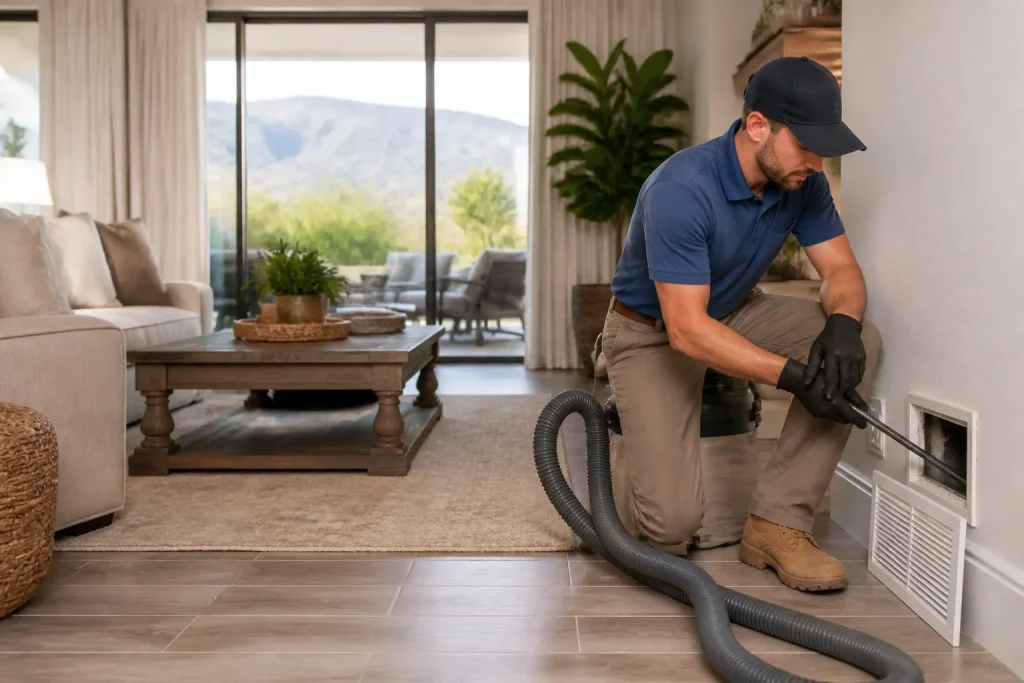
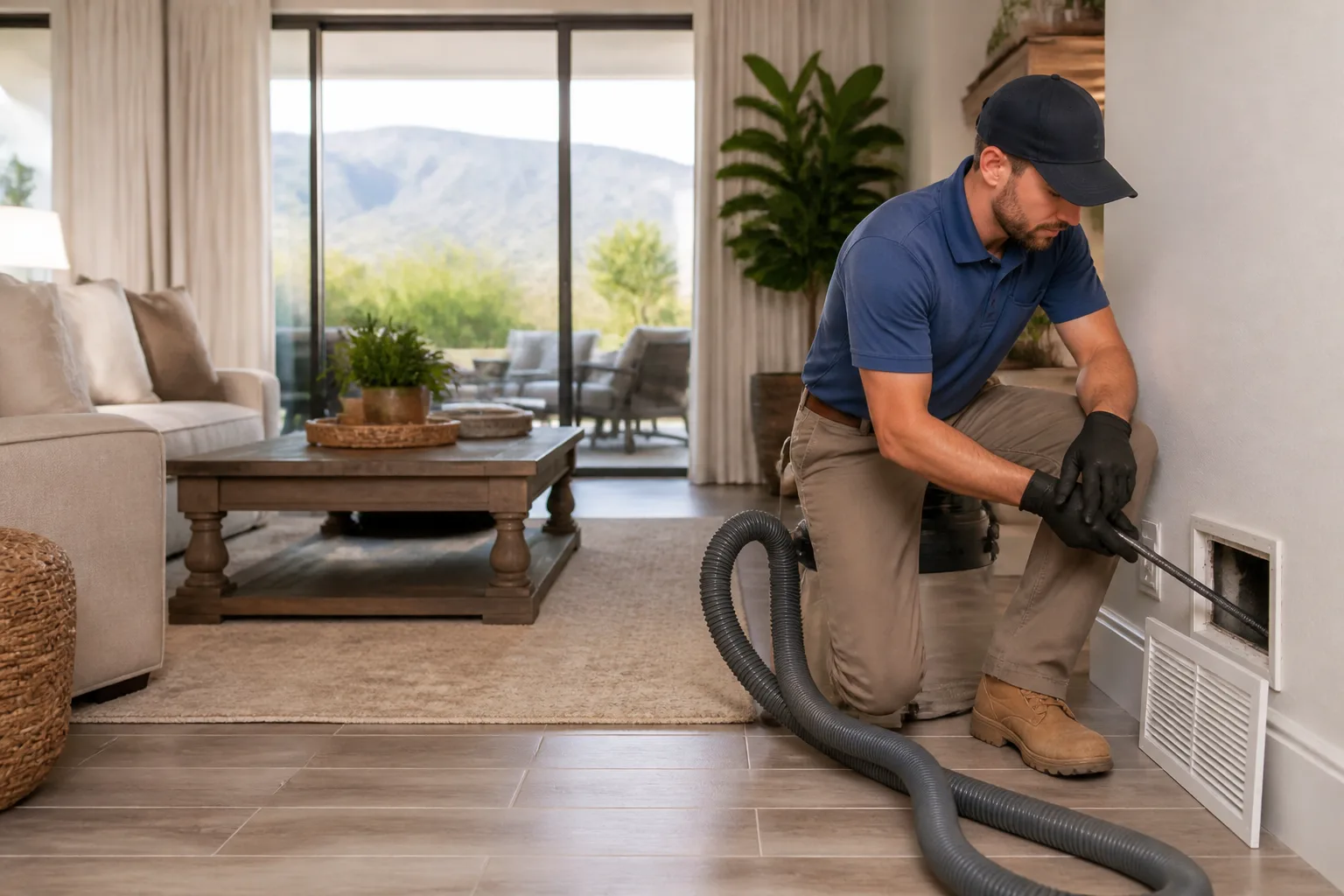
For a post-renovation job, professional-grade equipment matters more than it does for routine cleaning. Fine drywall dust coats the interior of the duct in a thin film that a shop vac won’t remove. A Rotobrush system agitates that film off the walls and a Nikro extractor pulls it out under negative pressure, with Abatement Technologies filtration equipment capturing what goes airborne. That’s the difference between a duct that looks clean when you peek into it and one that’s actually clean.
The right timing is after the dust settles, usually a week or so after the last sanding. Doing it mid-renovation means you’ll need it again. Waiting until the work is complete is the smart move.
When should you call a pro, and what should you say?
Call a pro when the triage above points to the ductwork and you can’t resolve it with a filter change and a check of the vents. When you do call, describe three things precisely: what you smell or see, when it started, and whether it’s constant or only when the system runs.
A good description gets the right technician to your door with the right equipment. Here’s a quick script for the call:
- “We smell something musty, and only when the air conditioner is running.”
- “After the dust storm, dust is blowing out of the supply vents in the back bedrooms.”
- “We just finished a kitchen remodel and there’s drywall dust everywhere, including the vents.”
- “Rooms that used to cool fine are weak now, and it started a few days ago.”
Those sentences tell a technician what to bring and how long to plan for the visit. “My ducts are dirty” tells them almost nothing.
If you’ve also noticed the dryer taking two cycles to finish a load, mention it. Dryer vent cleaning is a core part of what we do, and lint buildup in a dryer vent is a documented fire cause. It’s a safety service, not an upsell, and it’s worth flagging in the same call.
Related services in Buckeye: if your triage points to ducts, air duct cleaning is where it starts. If the dryer is slow, that’s dryer vent cleaning. If a duct run is disconnected, crushed, or damaged, we handle that as air duct repair under our full-service scope, and we can address it on the same visit once cleaning reveals the problem.
If you’re not sure which one you need, the honest answer is: call and describe it. We’ll tell you which service it is, or tell you it isn’t a duct issue at all.
The Bottom Line
Most duct emergencies in Buckeye aren’t duct emergencies. They’re an HVAC problem, a filter that needs changing, or post-monsoon dust that a fresh filter will handle. The five-minute triage in this guide tells you which one you’re looking at: burning smell means shut it off and call an HVAC tech, musty odor or visible debris means call a duct specialist, and a slow dust buildup means schedule it and stop worrying.
When the answer is duct cleaning, the details matter. The right equipment agitates debris off the duct walls and extracts it under negative pressure. Our technicians use Rotobrush and Nikro systems on every job, with Abatement Technologies filtration for contaminant capture, and we work with homes that run Honeywell and Aprilaire air-quality systems. We clean, we inspect, and if we find damage, we fix it.
If you’re in Buckeye and need help, Duct Cleaning Buckeye offers free estimates. Call (866) 361-5107. We answer 24/7. Fast dispatch from 7am to 7pm, Sunday through Friday. If you’d rather read up first, everything about how we work starts on our Duct Cleaning Buckeye page.
Frequently Asked Questions
Emergency cleaning applies when debris is actively blowing into living space, a strong musty odor appears only when the system runs, or a recent dust storm or renovation pushed a large volume of fine dust into the system. Routine cleaning is for general dust buildup over time with no triggering event. If you can’t tell the difference, a quick call with a description is the fastest way to find out.
No. A burning smell from your vents is an HVAC issue, not a duct cleaning issue. Turn the system off at the thermostat and call an HVAC technician. A faint dusty smell on the first startup of the season is normal and fades within an hour or two, but an acrid, electrical, or smoky smell is not.
Pricing is per job, set by a written estimate after we see the system. Cost depends on the size of the home, the number of runs, how accessible the ductwork is, and whether any repair is needed. We give one flat price per system agreed before work starts, with no per-vent pricing. Call (866) 361-5107 for a free estimate.
Duct cleaning removes the dust, debris, and settled contaminants that get pushed back into living space, and many homeowners notice a difference in how the air feels. It is not a medical treatment, and we don’t make health claims. What we can tell you is what’s physically inside the ducts before and after, with before-and-after photos of your own system so you can see the work that was done.
Written by the team at Duct Cleaning Buckeye.
Need Air Duct Cleaning Help?
Call Duct Cleaning Buckeye - licensed & insured, with free written estimates in Buckeye.
(866) 361-5107